
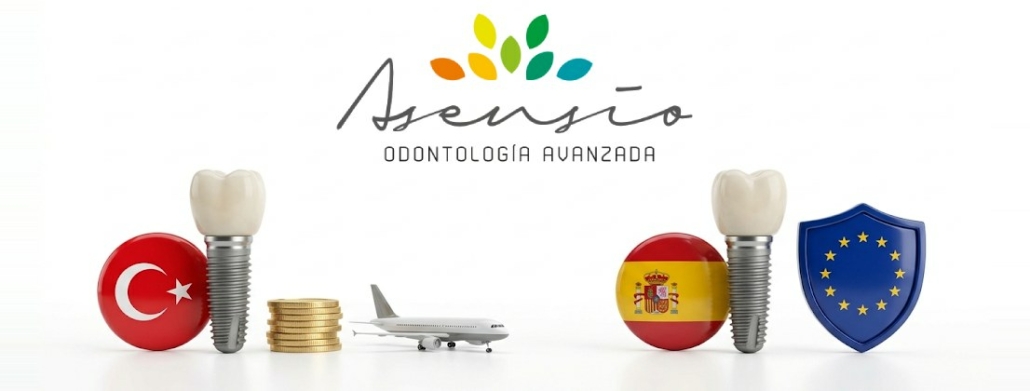
Dental Implants Turkey vs Spain
Dental implants Turkey vs Spain compares two destinations for the same procedure: a titanium post placed in the jawbone to replace a missing tooth root, topped with an abutment and a crown. The implant itself is not what differs between the two countries. The regulatory framework, the distance from the UK and the aftercare that follows the surgery differ.
You have two quotes and one question: what happens if something goes wrong after you fly home? Most comparisons answer with a price table. A price table does not tell you who regulates your dentist, how far you must travel for a review, or what your guarantee actually covers. Those three answers decide whether a cheaper quote stays cheap.
Asensio Advanced Dentistry in Valencia has treated patients since 1997, and Dr Lucía Asensio Romero has placed more than 5,000 implants. The clinic holds ISO 9001 certification from AENOR and places Nobel Biocare and Klockner implants. We are a clinic in Spain, so we have an interest in this comparison. For that reason, this guide relies on the General Dental Council’s guidance on going abroad for dental care, on the British Dental Association and on official sources, and it says clearly where the evidence stops.
Are dental implants in Turkey and Spain the same treatment?
The surgical procedure is the same in both countries. A dentist assesses the jaw with a scan, places the implant in the bone, and waits while the bone bonds to the titanium. This bonding process is called osseointegration. The dentist then attaches an abutment and fits a crown. A clinic in Istanbul and a clinic in Valencia can both use the same international implant systems, so the brand written on your quote matters more than the country printed on your boarding pass. Ask any clinic in either country to name the implant system, the manufacturer and the batch documentation for your implant.
The difference lies in the system around the procedure. Turkey and Spain each train dentists for five years, and each runs a registration system for dentists. They sit under different legal frameworks, though. Spain is a member of the European Union. Turkey has been an EU candidate country since 1999 but is not a member. The UK’s regulator, the General Dental Council, covers neither country.
The table below summarises the structural differences. The sources for each row appear in the sections that follow.
| Factor | Turkey | Spain |
|---|---|---|
| Dental degree | Typically five years, 300 ECTS credits, with a compulsory final-year internship | At least five years and 5,000 hours under EU Directive 2005/36/EC |
| Registration | Ministry of Health registration before authorisation to practise; private dentists also join a regional dental chamber | Regional Colegio de Odontólogos y Estomatólogos, under the national Consejo General de Dentistas |
| EU status | Candidate country since 1999 | Member state |
| Regulated by the GDC | No | No |
| Flight from London | Around 4 hours | About 2.5 hours (Heathrow to Valencia) |
How are dentists regulated in Turkey and in Spain?
The General Dental Council regulates dental professionals who work in the UK. The GDC states in its leaflet on dental care abroad: “We can’t guarantee another organisation like us exists in other countries.” The leaflet tells patients to check whether the destination country has a professional regulator and whether dentists must register with it. The GDC also points patients to healthregulation.org for information about regulators in other countries.
Turkey registers its dentists through the Ministry of Health. The Council of European Dentists’ 2026 profile of Türkiye states that dentists must register with the Ministry before receiving authorisation to practise, except those employed in public institutions. The same profile reports that private practitioners must also apply to their regional dental chamber. The Higher Education Board (YÖK) oversees the quality of dental education, and the dental degree typically lasts five years.
Spain applies the EU’s professional qualifications framework. Article 34 of Directive 2005/36/EC states that basic dental training “shall comprise a total of at least five years of study” and at least 5,000 hours of full-time theoretical and practical training. Spanish dentists register with their regional Colegio de Odontólogos y Estomatólogos, which belongs to the national Consejo General de Dentistas. Each registered dentist holds a registration number that you can request and check.
Regulation exists on paper in both countries, so a regulatory label alone does not separate them. What separates them is the legal framework behind the label. Treatment in Spain falls under Spanish law and treatment in Turkey under Turkish law. Neither route gives you access to the UK’s GDC complaints process. For that reason, ask each clinic for its registration number, its complaints procedure in writing and the name of the dentist who will treat you. Our page on dentistry in Spain and its standards for UK patients explains how this works in practice.
What do UK dentists report about complications after treatment abroad?
The British Dental Association surveyed 1,000 UK dentists about patients who had travelled abroad for treatment. The BDA reports that 86% of the dentists had treated cases that developed complications. Crowns were the treatment most likely to need follow-up work (87%), followed by implants (85%). Around two-thirds of the dentists said repairs cost patients at least £500, and one in five said repairs cost more than £5,000.
| Finding | Share of UK dentists surveyed |
|---|---|
| Had treated complications after treatment abroad | 86% |
| Reported crowns needing follow-up work | 87% |
| Reported implants needing follow-up work | 85% |
| Said repairs cost patients £5,000 or more | One in five |
These figures come from the BDA’s press release on dental tourism. The release does not name a destination country. The survey therefore does not show that Turkey performs worse than Spain, or that Spain performs better than Turkey. It shows that dentists see problems when patients travel for treatment without a plan for follow-up. BDA chair Eddie Crouch said: “If there are complications, the initial price may not be such a bargain.”
TravelHealthPro, the UK’s travel health information service, adds that problems can emerge weeks or months after treatment. It advises that follow-up care abroad may be hard to reach and may not be NHS-funded. NHS Fife notes that NHS Scotland is under no obligation to provide pre- and post-operative care other than emergency care. Both statements apply to any destination, so they weigh equally on Turkey and on Spain. In practice, the risk sits in the plan for follow-up, not in the airport code.
Flights, healing time and follow-up: why distance matters
An implant needs months to heal, not days. The bone must bond to the titanium before the dentist can finish the restoration, so a clinic abroad cannot treat the implant as a single appointment. Your dentist sets the number and timing of visits for your case. Ask the clinic to write the full schedule down before you pay a deposit. A clinic that refuses to put the visit schedule in writing leaves you to guess the cost of the whole trip.
Distance changes how easy each review is. Heathrow to Valencia is about 832 miles, and the direct flight takes around two and a half hours. London to Istanbul takes roughly four hours. A shorter flight does not make a clinic better. It does make a short-notice review, a loose crown or a swelling easier to deal with, because you can reach your dentist sooner.
| Practical factor | What to do |
|---|---|
| Fit to fly | Ask your dentist or doctor to confirm you can fly after surgery. TravelHealthPro warns that long flights after surgery raise the risk of venous thromboembolism. |
| Travel insurance | Buy cover that includes complications. TravelHealthPro states that the GHIC does not cover the cost of planned treatments. |
| Records | Carry copies of your scans, treatment notes and implant details so a UK dentist can treat you later. |
| Your UK dentist | Tell your own dentist about your plans before you travel, as the GDC advises. |
Our guide to dental implant recovery explains what to expect in the first days, weeks and months. Our page on how dental treatment in Spain works describes the practical steps of planning the trip.
What should a written guarantee and aftercare plan include?
A guarantee is only as useful as its written terms. The GDC lists the questions every patient should ask a clinic abroad. These questions apply equally to a clinic in Turkey, a clinic in Spain and any other destination. Ask for the answers in writing, and do not commit to treatment on the day of the consultation. A clinic that answers these questions plainly gives you something to hold it to later.
| Question to ask | Why it matters |
|---|---|
| Who will treat me, and how are they qualified? | The dentist who places your implant should be named, registered and able to prove any specialist title. |
| Is the work guaranteed, and for how long? | The guarantee should state which parts it covers and for how many years. |
| Who pays for extra flights, hotels and remedial work? | A problem can cost more in travel than in treatment, and the quote rarely says so. |
| Does the clinic have insurance and a complaints system? | You will not have access to the GDC process, so the clinic’s own process matters more. |
| Who do I contact after I return home? | You need a named person and a response time, not a generic inbox. |
Asensio’s dental guarantee gives a lifetime guarantee on Nobel Biocare and Klockner implant material, backed by the manufacturer and the clinic, and a five-year guarantee on crowns and bridges. The guarantee applies wherever the patient lives after treatment. Ask us, as you should ask any clinic, who pays for extra flights, hotels and remedial work, because the guarantee page sets out the terms and exclusions in full.
Is Turkey cheaper than Spain, and is price the right test?
Turkish clinics usually quote lower prices than Spanish clinics, and the gap is the main reason UK patients compare the two. We do not repeat price ranges here, because a headline price depends on what a quote includes. Compare itemised quotes instead. Our price list shows what each treatment costs at Asensio, and our guide to the best countries for dental implants abroad compares more destinations.
The total cost of treatment is higher than the quote. It includes the implant, the abutment, the crown, the scan, the consultation, flights, hotels and any return trips. It also includes the cost of fixing a problem. The BDA survey reports that around two-thirds of dentists said repairs cost patients at least £500. A quote that omits the scan or the abutment looks cheaper than it is. Add each of these lines to your own spreadsheet before you compare two clinics.
| Cost item | Check that the quote states it |
|---|---|
| Implant, abutment and crown | Each part is listed separately, with the implant brand named. |
| Scan and consultation | The 3D scan and the planning appointment are included or priced. |
| Travel and accommodation | Flights, hotels and transfers are either included or estimated. |
| Return visits | The number of visits and who pays for them are stated. |
| Remedial work | The guarantee states what is repaired free of charge and what is not. |
If you want a second opinion before you choose either country, send us your existing X-rays. We will give you a preliminary assessment before you book any flights, as described on our page about dental implants abroad in Valencia.
Frequently asked questions about dental implants in Turkey vs Spain
Are dental implants cheaper in Turkey than in Spain?
Turkish clinics usually quote lower prices than Spanish clinics. The quote alone does not show the total cost. Compare itemised quotes that name the implant brand, list the crown and the scan, and state the guarantee, then add flights, hotels and the cost of any return visit. Our price list shows what each treatment costs at Asensio.
Is it safe to get dental implants in Turkey?
Safety depends on the clinic, the dentist, the complexity of your case and the aftercare, not on the country alone. The BDA survey of UK dentists does not break its results down by destination. Check the dentist’s registration, ask for the guarantee and complaints procedure in writing, and talk to your own UK dentist before you travel.
Is dentistry in Spain regulated by the EU?
Spain is an EU member state, and EU Directive 2005/36/EC sets minimum training for dentists at five years and 5,000 hours. Treatment in Spain still falls under Spanish law, and the UK’s GDC does not regulate it. Spanish dentists register with their regional Colegio de Odontólogos y Estomatólogos.
Can I complain to the GDC about a dentist abroad?
The GDC regulates dental professionals who work in the UK. Its leaflet on going abroad for dental care does not describe a complaints route for treatment abroad. It advises patients to check the destination country’s regulator and to ask the clinic whether it has a complaints system. Ask to see a copy before you book.
How long is the flight from the UK to Spain and to Turkey?
The direct flight from London Heathrow to Valencia takes around two and a half hours. A flight from London to Istanbul takes roughly four hours. Flight times vary by airport and route, so check your own departure airport.
Will the NHS fix problems from dental treatment abroad?
The NHS does not guarantee follow-up care for treatment you had abroad. NHS Fife notes that NHS Scotland is under no obligation to provide pre- and post-operative care other than emergency care. TravelHealthPro advises that you may need to pay for further treatment yourself. Plan and insure your follow-up before you travel.
What guarantee does Asensio give on dental implants?
Asensio gives a lifetime guarantee on Nobel Biocare and Klockner implant material, backed by the manufacturer and the clinic, and a five-year guarantee on crowns and bridges. The guarantee applies wherever you live after treatment. Read the full guarantee terms before you decide.