
All-on-6 Dental Implants Abroad: Complete Guide for UK Patients
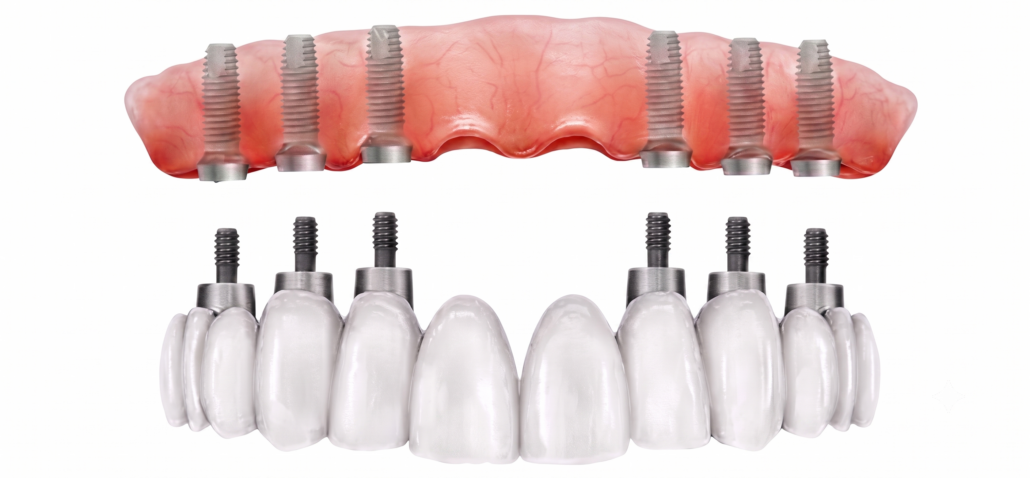
All-on-6 dental implants abroad is a full-arch rehabilitation technique that replaces all the teeth in one jaw using six strategically placed implants, supporting a fixed prosthesis from the day of surgery in many cases. For UK patients travelling to Spain, All-on-6 uses the same Nobel Biocare implant systems found in British clinics at 55% to 70% lower cost, backed by a lifetime guarantee on materials.
Deciding between All-on-4 and All-on-6 can feel confusing when different clinics recommend different numbers of implants for what sounds like the same problem. The truth is that the right technique depends on your available bone volume, bite force and long-term functional goals — not on whichever package a clinic happens to sell. Choosing the wrong option can mean paying for implant support you don’t actually need, or accepting less long-term stability than your jaw could support.
At Asensio Advanced Dentistry in Valencia, All-on-6 cases are planned and performed by Dr. Lucía Asensio Romero, a specialist in implantology and oral surgery with over 30 years of experience and more than 5,000 implants placed — her clinical credentials are independently verifiable on Doctoralia. Using 3D digital planning and guided surgery, we assess each patient individually to determine whether All-on-4 or All-on-6 is the appropriate technique for their anatomy.
What is All-on-6 and how does it work?
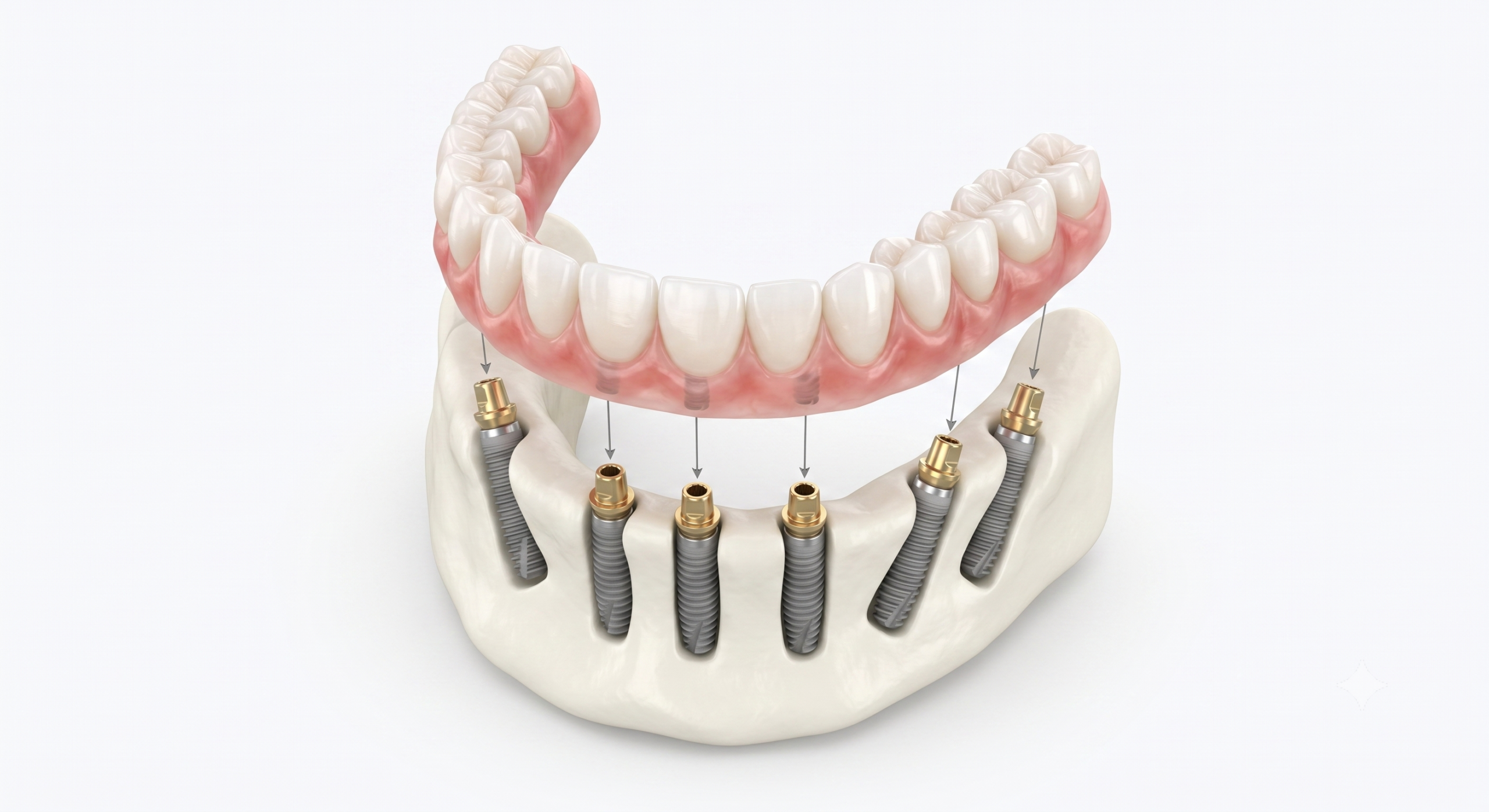
All-on-6 uses six implants per arch to support a full-arch fixed prosthesis, typically distributed with two implants at the front of the jaw and two on each side towards the back, following the natural curve of the arch. Compared with All-on-4, the two additional implants spread the biting load across a wider area of the jawbone, which increases the total surface contact between implant and bone and can provide additional mechanical support in patients whose bone volume is good throughout the whole arch, not only at the front.
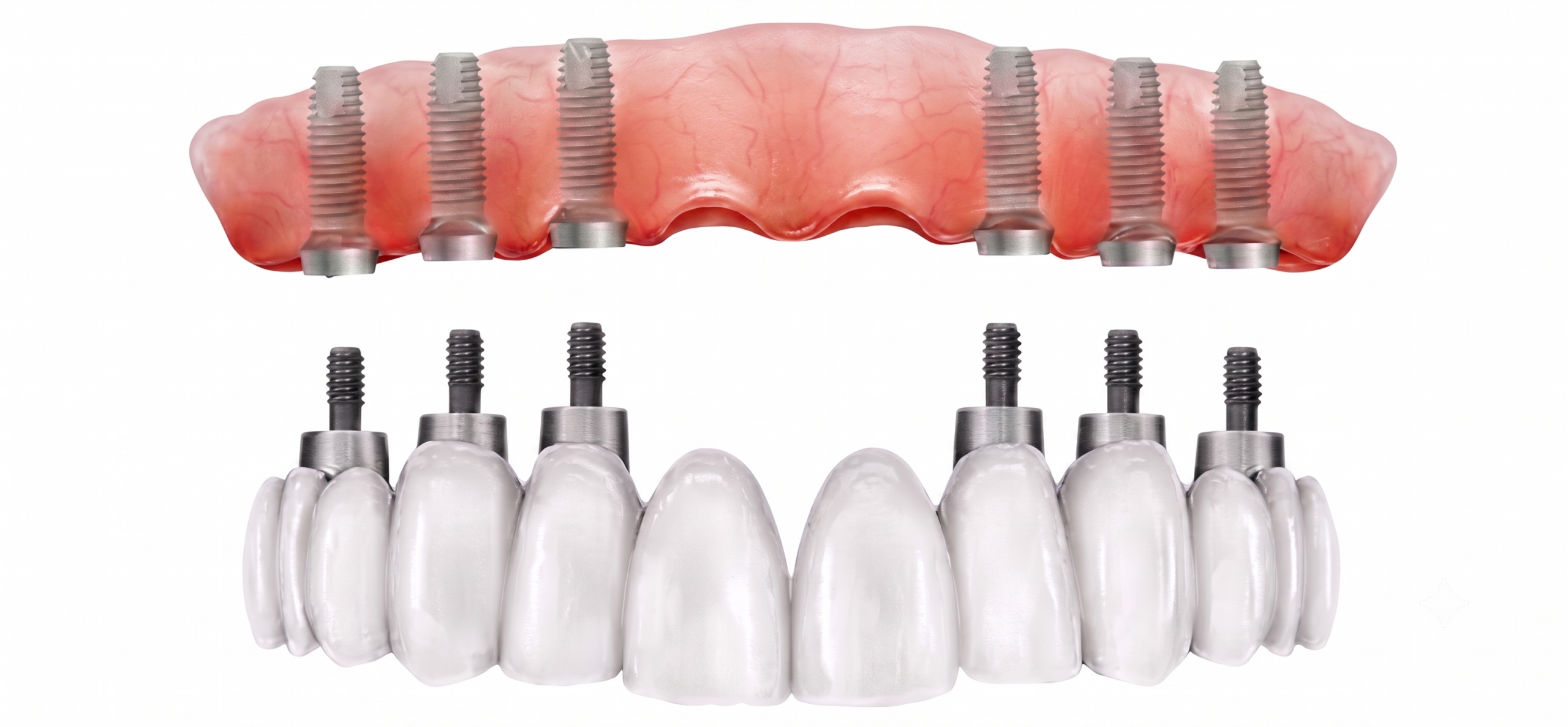
The surgical principle behind All-on-6 is the same as All-on-4: implants are placed using guided 3D surgery planned from a CT scan, and — when the implants achieve enough primary stability at the time of surgery — a fixed provisional prosthesis can be fitted on the same day. The healing period that follows allows osseointegration, the biological process in which bone fuses directly onto the titanium implant surface, to take place before the definitive prosthesis is fitted. All-on-6 restorations are usually finished with a zirconia or a hybrid acrylic-and-titanium prosthesis, and the material is chosen based on bite force, aesthetic preference and budget.
All-on-6 developed alongside All-on-4 as full-arch implant dentistry matured over the past two decades, and both techniques now have long-term published clinical data supporting their use. Neither technique is inherently superior in isolation: All-on-4 was specifically engineered to work with limited bone by angling the two posterior implants at 45 degrees, while All-on-6 is designed to add implant support wherever the patient’s bone volume allows it across the full arch. Which technique suits a given patient is determined by clinical assessment of their bone and bite, not by how a package happens to be marketed.
All-on-6 vs All-on-4: which technique is right for you?
Both techniques replace a full arch of missing or failing teeth with a single fixed prosthesis, and both are available at Asensio using Nobel Biocare or Klockner implants under the same lifetime guarantee on materials. The table below summarises the main clinical differences between the two options.
| Factor | All-on-4 | All-on-6 |
|---|---|---|
| Number of implants per arch | 4 | 6 |
| Bone volume required | Works with limited bone via angled posterior implants | Needs adequate bone volume across the full arch |
| Bite force distribution | Concentrated across 4 support points | Distributed across 6 support points |
| Best indicated for | Full arch loss with moderate to limited bone | Full arch loss with good bone volume and higher bite force needs |
| Likelihood of bone grafting | Low — specifically designed to avoid it | Low to moderate — depends on posterior bone density |
| Typical cost | Lower — fewer implants | Higher — two additional implants |
In practice, most patients with significant bone loss — particularly at the back of the jaw — are better candidates for All-on-4, which was engineered specifically to work with reduced bone by angling the posterior implants at 45 degrees to maximise contact with the bone that is available and avoid anatomical structures such as the sinus or the mandibular nerve. Patients with well-preserved bone volume across the whole arch, a naturally strong bite, or a history of breaking dentures, bridges or previous implant restorations under heavy biting force, may benefit from the additional mechanical support that six implants provide compared with four.
Both options are assessed during the free first consultation using a 3D CT scan, and the final recommendation is made only once your bone volume, bite pattern and overall clinical situation have been reviewed — never before. It is also common for the two techniques to be combined asymmetrically within the same patient, for example six implants on one side of the arch where bone allows it and a more conservative approach on the other, depending on what the CT scan shows. For a complete overview of every implant option we offer, see our dental implants abroad page.
All-on-6 dental implants abroad: cost considerations
All-on-6 costs more than All-on-4 because it uses two additional implants, and each implant adds to the surgical, material and laboratory cost of the case. As a reference point, a single-arch All-on-4 at Asensio starts from £6,959, including extractions, four implants and a fixed provisional prosthesis fitted on the day of surgery, with both arches from £13,052 — All-on-6 sits above these figures, with the exact difference depending on the number of additional implants ultimately needed, the implant brand selected, and the material chosen for the final prosthesis.
What stays constant across both techniques is the scale of the saving compared with UK prices: patients travelling from the UK to Valencia for full-arch implant treatment typically save 55% to 70% versus equivalent private treatment at home, using the same Nobel Biocare and Klockner implant systems and the same lifetime guarantee on materials that a UK clinic would offer, at a fraction of the cost. The 3D CT scan used to plan every full-arch case, whether All-on-4 or All-on-6, costs £79 at Asensio versus £250 or more typically charged in the UK, and is included automatically as part of the treatment quote once a patient proceeds.
Because All-on-6 pricing depends heavily on individual anatomy — bone volume, the final number of implants placed and the prosthesis material chosen — we do not publish a fixed headline price for it in the way we do for All-on-4. Every All-on-6 case is quoted individually after the free first consultation, which includes the 3D CT scan and a written, itemised treatment plan with no obligation to proceed, so you know the full cost before committing to travel. View our full treatment price list for reference pricing on related procedures, or call us free on 0800 048 8058 for a personalised estimate.
The All-on-6 procedure step by step
| Stage | What happens | Visit required |
|---|---|---|
| 1. Free consultation | OPG X-ray, 3D CT scan, bone volume assessment, personalised treatment plan | Yes (or remote assessment) |
| 2. Surgery day | Extractions, 6 implants placed, fixed provisional teeth fitted same day where primary stability allows | Yes |
| 3. Osseointegration | 3–6 months healing at home in the UK with provisional fixed teeth | No |
| 4. Final prosthesis | Definitive zirconia or hybrid restoration fitted and adjusted | Yes |
Most All-on-6 cases require two trips to Valencia, in the same way as All-on-4, with direct flights available from multiple UK airports in around two and a half hours. The first trip covers the consultation and the surgery itself, which can often be scheduled on consecutive days to minimise time away from home and work. During this visit, any remaining failing teeth are extracted, the six implants are placed under local anaesthesia using guided 3D surgery, and — where primary stability allows — a fixed provisional prosthesis is fitted before you fly home, so you are never without functional, fixed teeth. Conscious sedation with nitrous oxide is available throughout for patients who feel anxious about dental treatment, and most patients report manageable discomfort rather than severe pain in the days following surgery.
The osseointegration period that follows lasts approximately three to six months and is spent at home in the UK, wearing the fixed provisional prosthesis and going about normal daily life with only minor dietary adjustments while the implants settle. During this time the six implants fuse gradually with the surrounding jawbone, building the mechanical stability that will support the definitive restoration long term. You return to Valencia for a second visit once osseointegration is confirmed, at which point the provisional prosthesis is removed and the definitive zirconia or hybrid prosthesis — custom designed from impressions and digital scans taken earlier in the process — is fitted and fine-tuned for bite and appearance before you fly home with your final, permanent teeth. Find out more about how our dental tourism process works.
Who is a good candidate for All-on-6 abroad?
All-on-6 is generally indicated for patients who have lost, or are about to lose, all the teeth in one or both arches, but who retain good bone volume throughout the jaw — not only at the front. Patients with a naturally strong bite, a history of bruxism, or those who have previously broken removable dentures or fixed bridges under heavy biting force, are often good candidates, since distributing the load across six implants rather than four can offer additional long-term mechanical support in these specific situations.
All-on-6 is not usually the right choice for patients with significant bone loss in the posterior jaw, since placing six implants successfully requires adequate bone across a wider area than All-on-4 needs. In these cases, All-on-4 — which angles the posterior implants specifically to work around limited bone — or, in cases of severe maxillary atrophy, zygomatic implants anchored in the cheekbone rather than the jaw itself, are usually the more appropriate route. This is precisely why bone volume is always assessed with a 3D CT scan before any technique is recommended: the number of implants should follow the patient’s anatomy, never the other way around.
Patients replacing an older, failing full-arch restoration — for example a worn implant-supported bridge, or implants placed many years ago that are now failing — are also frequently suitable for All-on-6, particularly when the goal is to upgrade to greater long-term stability. As with any full-arch case, general health factors such as uncontrolled diabetes or heavy smoking are reviewed during the free consultation, since they affect healing and long-term implant success regardless of how many implants are ultimately placed.
Why choose Asensio for All-on-6 dental implants abroad?
We use exclusively Nobel Biocare and Klockner implants — two of the most clinically validated implant systems in the world — and back every All-on-6 case with a lifetime guarantee on materials. Our ISO 9001 certification from AENOR means our clinical processes are independently audited to the same standard applied to major European hospital groups, and every full-arch case is planned using a Planmeca Promax 3D digital scanner and guided surgery before a single implant is placed, giving both surgeon and patient a precise, predictable plan from the outset rather than a generic package.
We also accept complex cases that other clinics have turned away, including patients with uneven bone density across the arch who need a combined approach — for example a standard implant pattern on one side of the jaw and additional support or a different technique on the other, depending on what the CT scan shows. Every case is reviewed individually in our 500m² clinic in Valencia rather than fitted into a fixed package, and second opinions are welcome for patients who have been quoted elsewhere. Call us free on 0800 048 8058 or email office@dentalasensio.co.uk to discuss your case.
Once your All-on-6 restoration is fitted, daily cleaning is essential to protect it for the long term, and the maintenance routine is essentially the same as for All-on-4: a specific full-arch or interdental brush, a water flosser to clean beneath the prosthesis, and a professional hygiene review roughly every six months. Neglecting this routine is the leading cause of peri-implantitis, the bacterial infection that is the most common reason full-arch restorations fail over time. See our full-arch implant cleaning guide and our general dental implant care guide for the complete routine.
Frequently asked questions about All-on-6 dental implants abroad
How much do All-on-6 dental implants cost abroad?
All-on-6 costs more than All-on-4 because it uses two additional implants, and the exact price depends on bone volume, implant brand and the final prosthesis material. As a reference, single-arch All-on-4 at Asensio starts from £6,959; All-on-6 is quoted individually after a free consultation and 3D CT scan. UK patients typically still save 55% to 70% compared with equivalent private treatment at home. View our prices page for reference costs.
Is All-on-6 better than All-on-4?
Neither technique is universally better — the right choice depends on your bone volume and bite force, not on the number of implants alone. All-on-4 was specifically designed to work with limited bone, while All-on-6 adds support where bone volume allows it across the whole arch. We recommend the technique that fits your anatomy after a 3D CT scan, not the one with more implants by default.
How many implants does All-on-6 use and where are they placed?
All-on-6 uses six implants per arch, typically two at the front and two on each side towards the back, following the curve of the jaw. This distributes bite force across a wider area of bone than the four implants used in All-on-4.
How many trips to Spain does All-on-6 require?
Typically two trips, the same as All-on-4. The first covers the consultation and surgery, which can often be scheduled on consecutive days. You return home with fixed provisional teeth and come back three to six months later for the definitive restoration.
How do I clean All-on-6 dental implants?
The cleaning routine for All-on-6 is the same as for any full-arch implant restoration: daily brushing with a specific full-arch or interdental brush, a water flosser to clean under the prosthesis, and professional hygiene reviews every six months. See our full-arch implant cleaning guide for the complete routine.
Related guides
- All-on-4 dental implants abroad — full arch rehabilitation with fewer implants, for patients with limited bone
- Dental implants abroad at Asensio — full overview of every implant option we offer
- All-on-4 cost in Spain — full price breakdown and UK comparison
- Zygomatic implants — when standard implants aren’t possible due to severe bone loss
- How to clean full-arch implants — daily routine, tools and professional care
- Dental implant recovery — what to expect after full-arch surgery
- Best countries for dental implants abroad — how Spain compares for UK patients
- How dental tourism in Spain works — planning your trip to Valencia